Friday, February 23, 2007

The Shangri-La School

My dear readers. I have included this newspaper article from Iowa Source, which I just received from Pam a good friend of mine. Pam is like very didi (big sister) to me. She has been so grateful and so helpful for all the needy out there. She has been sponsoring a Buddhist monk as well, who is my brother Karma for so long. Thank you from our heart to Pam didi. Namaste.

Prem

The Shangri-La School
Local Families Sponsor Education for Some of Nepal's Poorest Children
BY CAREE CONNET


Thailai was in poor health when she arrived at the school in 1994. Today, she's a radiant, vibrant child.
Sometimes a village is too poor to feed a child; sometimes an entire country is too poor to feed all of its children. Nepal, the only official Hindu state in the world, is one of the least developed countries, with a third of the population subsisting below the poverty line. This landlocked Himalayan kingdom, squeezed between India and China, suffers from a lack of natural resources and roads, deforestation, erosion, and vehicular emissions. Nepal’s terrain, which ranges from the world’s highest peaks to steep hills to subtropical jungles, limits the amount of arable land, and tourism has declined in recent years due to political unrest.
In spite of these difficulties, the Nepalese are extremely friendly, cheerful people. Faced with a challenging situation, they will say, “No problem.” If it really is a problem, they’ll say, with a philosophical shrug, “What to do?”
“I kept asking myself the same question,” Pam Whitworth tells me, as we drink chai in her spacious kitchen overlooking the cornfields of southeastern Iowa. “During my first trip to Nepal in 1995, I fell in love with the country, its stunning landscape, and its warmhearted people. But I also saw what poverty is and how cruel it can be, especially for children. . . . We have so much in our culture, and it takes so little to make a difference in their lives. There’s so much inequality in our world, so to be able to correct that imbalance in any small way feels like the right thing to do.”
I nod in agreement. In 1998, my husband and I joined Pam for a trek in the Annapurna region. I could never forget the sight of children begging in the streets or doing backbreaking work.
From Shy Child to Gentle Man
Not long after her first visit, Pam began sponsoring a Nepalese child. Her friend Martha, who was living in Kathmandu, had a cook with two children, very poor. This young mother would never be able to afford to send her children to school. Martha, along with her mother, decided to sponsor them at a school close to where she lived. She discovered that the principal was supporting quite a few children from very poor, remote villages who were orphans, or had only one parent. This man was trying to make some small contribution to their lives. He had a long waiting list of needy kids, and he asked Martha if she knew anyone who might be willing to sponsor a child.
“So Martha asked me, and I immediately said yes,” Pam recalls. “Punya, the boy I’ve sponsored for ten years, has no father. His mother works in a carpet factory making $20 a month. There are four kids in the family, and now we sponsor all of them. Punya was just a tiny, extremely shy little boy when I first met him. Now he’s taller than I am, and a sweet, gentle young man. He’s like a big brother to all the kids. When I was recently in Nepal, he told me with tears in his eyes that he didn’t know what would have become of him if I hadn’t sponsored him. He said his mother was so grateful, and wanted him to thank me for helping her children.”
One Child Led to Another
There was always a waiting list of children in need, and an endless litany of heartbreaking stories. This one’s mother died and the father ran off, leaving the child with an elderly grandparent who could not afford to feed the child. The father was dying and the mother was working in India on a road crew, and the villagers could not cope. There were no parents and someone found the child on the street. Or there were parents but they were too poor to pay any school fees.
The Personal Connection
Pam realized she could not sponsor all of them. So she asked friends who she thought might be willing and able to sponsor a child, and many, in turn, said yes. Some, like myself, have a strong connection to Nepal, and others are attracted to the personal aspect, knowing the child they are sponsoring. And others like the idea of a small charity where they know that 100 percent of their money goes directly to the recipients. The children all know their sponsors, and they love knowing someone is concerned about their welfare, their education, their life. Many sponsors write and send pictures or small necessities, and the children write letters or send drawings.
Pam has been the coordinator over the years. She stays in touch with the school, acting as a channel for communications and for the funds to flow. “It’s not so easy to get money from here to there,” she says. “Over the past year Martha has gotten much more involved, offering to act as a conduit for the funds. This has been so helpful. I can be sure the money gets to the kids. Also, she lives close to the school and can check on the kids regularly, and they stop by to visit her. This way, she keeps me informed about how they are and what they may need.” Pam in turn relays information to the sponsors, and discusses any special needs their child may have, as well as organizing exchanges of letters and pictures.
The Children’s Stories
Pam has been keeping a photo album of the children for all these years. The pictures record the life of each child, and every year there are more new faces. She shows me the most recent picture of the girl I sponsor, Thailai Lama, smiling radiantly at the camera. Pam flips back to the beginning of the album, and points out Thailai in a group photo. I hardly recognize her as the same girl.
“When I think of the kids’ stories,” Pam says, “the one image that comes to mind is Thailai. When I first saw her in 2000, she was this little kid from a far-off village in the mountains, like the kind we saw during our trek. She was in very poor health. She had scabies, her skin was all messed up, and her hair was cut short because she probably had head lice. She kept her head down and wouldn’t look at us. She looked so scared. And now, after seven years, look at her. She’s bright and happy and healthy.”Pam feels that the love and attention the kids receive from their sponsor nourishes them. They in turn feel a very special love for the person on the other side of the world who is making their lives better. Many of the kids call their sponsor Mother or Father.
Pam shows me photos of two more children. “Like Thailai, Wangdu and Jhangjuk are from a very remote area in Humla, in western Nepal, so they almost never see their families,” Pam continues. “Wangdu sees his maybe every two or three years. They can’t afford to travel that far. Wangdu is really smart, good in everything, sports, and academics. He’s going to be a real leader when he gets older. Jhangjuk has an older brother in Kathmandu who looks after her, but he’s gone for long periods of time. . . . But the other two kids, we have to do everything for them—make sure that they have clothing, medical attention, hair cuts, and shoes. We really have to be parents for the ones who have no family to take care of them.
“Last fall, I really felt compelled to go and visit the kids because they had just moved into a new school, Shangri-La. We moved them last year from their old school, where they had been for many years, but conditions had deteriorated and the kids weren’t happy. Now they are settled and very happy. It’s private, which means non-religious, as are all schools that are any good in Nepal. Public schools there are less than sub-standard, horrible, virtually useless.”
Pam shows me a picture of a smiling man with a mustache. “This is Mr. Karki, the principal, at Shangri-La. Our kids are the only boarders at this school, because this principal will only take boarders who are very, very poor. Many rich parents want their children to board at school, because everything is taken care of, but Mr. Karki will not take those children, even though he could make money that way. Our kids, who stay in the hostel, are like a family. He doesn’t want them to feel disadvantaged by wealthy families bringing food and money to their children, things our kids don’t have. He feels very solicitous of our kids. He’s such a sweet man. You can just see it in his face.
“When I was there, Martha and I had a big picnic for the kids. We’d planned it for months. They kids played games, ran up and down, and had lunch. We had a grab bag of school supplies that I brought with me. All of the sponsors sent photos and letters. The kids were so excited. They sat in the grass and poured over those letters. I also put together a photo album of all the sponsors. They loved that! They love photos. It means so much to them that someone is taking time to connect with them, plus they are terribly curious about America.
“For a lot of these kids, their lives have been really tough. They’ve had to grow up early and haven’t had time to be kids. At this new school, they have a big playground where they can play basketball and soccer and games, and Mr. Karki has planted trees and flowers around the school. He also arranges for the children to go on field trips on occasion.”
Kids on the Waiting List
I ask Pam why she took on the huge task of managing essentially a private charity.
“It was so natural, because of my love of Nepal,” she replies. “The bottom line for me is the heart value. That’s why I’ve done it, and why I continue to do it, and why other people become sponsors. When I do anything for a child, even chatting with a sponsor or writing an email to the principal with a question about one of the kids, it just makes me happy. It’s that thing of doing for someone else, and with children, there’s so much they can’t do for themselves.
“When we had that picnic, it was so much fun. They ran and played games and had party food. They don’t have those kinds of things in their lives. I want them to have that feeling in their heart: Someone cares about me.“On this last trip I bought disposable cameras for each child, so they could record their daily life for their sponsors. Most had never used a camera, so it was a quite exciting for them. It’s the kind of thing parents here would do, but their parents can’t. In our society we think about doing creative things with kids, but they don’t have that kind of exploratory education. So it was fun to do. It makes me think about what other projects we might do.
“This sponsorship program has been a very simple grassroots thing that has grown organically. Every penny that comes in goes directly to the children, so you really know what your money is doing and who it’s doing it for. You see how the kids’ lives are changed. You know their stories. It’s putting a real face on charity. Right now there are about 20 sponsors that I organize and 14 children that we support. Some kids, like Vikram, have multiple sponsors. Martha has her own group of additional kids and sponsors. Altogether we have almost 25 kids. But the little ones on the waiting list . . . those we think about all the time.”
The total cost to sponsor one child for an entire year is $675, which covers school fees, room and board, books, and uniforms. Some people co-sponsor, sharing the cost with one or more friends. If the child has no family, the sponsor should also be prepared to provide for extra expenses, such as simple clothing and basic medical care.
“More than ever on this last trip I saw how little it takes to give them a new life, with some security,” Pam says, “and how much it means to them just having somebody care about their welfare, their happiness, and their future. It’s basically what every human being deserves, isn’t it?”
To Sponsor a Child
If, in the spirit of this season of love and friendship, you would like to make a heart-to-heart connection with a Nepalese child, please contact Pam Whitworth at (641) 472-8955 or pamwhit@lisco.com.

For more articles on Fairfield, Iowa, see the Index.
HomeAbout • Advertising: Classified AdsDisplay Advertising • Articles: Advice & MannersAnimals & PetsArts & EntertainmentBooksBusiness & InvestingConscious LivingFoodHealth & BeautyHome & GardenInternet & ComputingMoviesPoetry & LiteratureTravel & RecreationWit & WisdomContributorsDistributorsIowa DirectorySubmissionsSubscriptionspowered by gourt
Copyright © 2006 The Petrick Company, Inc. All rights reserved.

Thursday, February 15, 2007

Wisdom Wednesday @ the Door County YMCA


Meditation & Relaxation


Sturgeon Bay- Y- Wisdom Wednesday
on Feb 14th 07

Namaste - Lets respect & honor each other first.

Breath Breath Breath

Breath for mind, Breath for body, & breath for your soul.

Vipassana Meditation has many benefits in our daily lives.
Breath - a Bridge to Meditation
“Breath - Present moment
Breath- reach to the source of life
Breath -transcend time and space
Breath - Be in the world & beyond” Osho

Vipassana is pure essence. You cannot add anything to improve it nor you can drop anything out of it.
First - breathing
Second - nostril
Third - Thoughts (awareness on everything you do from morning till night).

Let go - ego, attachments, anger, hatred, jealousy & negative clinging.

Practice-compassion, love, kindness, empathy & altruism.

Karma - Universal law of cause & effect.
Is Karma a fate or destiny? NO. Karma is created by our thoughts. We have the will power to accumulate good Karma as much as we can as well as bad ones.
Understanding Karma is like understanding yourself because it starts with you and your Karma is only for u.

Can Karma be changed? Yes! How? With our thoughts. Pure thoughts, selfless thoughts.
Can this be possible in this age? Yes, very much so. We can do it better now than ever.

Therefore, “Wisdom is not knowledge, wisdom is not experience & wisdom is not thinking. Wisdom is the attitude of no-self.

Compassion is not sympathy, compassion has no fix recipient and compassion is without a goal. Compassion is impartially benefiting all sentient being in just the right way.” Sheng Yen.

Buddha’s teaching : “The truth of suffering, the truth of origin of suffering, the truth of the cessation, and the truth of the path leading to this cessation.”
How? Eight fold paths. 8 rights.

“Love & compassion are necessities, not a luxury, without them humanity will & cannot survive, Dalai Lama”

“Be the change you wish to see in the world“, Gandhi

Next Mantra not om but BREATH.

Breaaaaaaaaaaattttttttttttthhhhhhhhhhhhhhhhhh

Conscious breathing, awareness breathing - living fully.
I breath in - I am alive - I breath out - I smile- Tich Nath Han

“Do everything with (clarity of your) mind & (with awareness) then there is Buddha Nature in you” Prem Lama

Tuesday, February 13, 2007

More Himalayan Presentation at Southern Door High School, Sturgeon Bay


Once again, I was able to give "Places & Faces of the Himalaya" for a local school (Southern Door High School) here in Sturgeon Bay, WI for "World History" Junior students, which is taught by Luke Goral. Here are some of the shots we took from the presentation. My presentation were for two different classes. My presentation focuses on People, landscapes (geography), lifestyle, economy, environment and culture of Himalayans. Mr. Goral had some questions and I hope I answered them well because the purpose behind it is to share information to one another and make this world a small place. Even though a drop in big ocean, still means a lot, without those drops ocean could not have been ocean. So, bottom line is no matter what we contribute, still it is contribution and it counts. At least for me.
I was not able to take picture for the second one because of the time factor but both of the class students enjoyed the presentation and I hope they learned something from it. I am really happy to do what I do. This is the way to introduce Nepal and Nepali people to the world. At least that is what I think. So, let me know if you need a speaker for any event.

Prem

Friday, February 09, 2007

Places & Faces of the Himalaya


Some pictures from the Presentation "Places & Faces of the Himalaya @ North East Wisconsin Technical Collage for Door County Learning and Retirement.


Prem

Tuesday, February 06, 2007

Samantabhadra (Universal Goodness)


By Prem Lama in Buddhist Deities !!!Published: Tuesday, 06 February 07 - 03:21 PM (GMT)
SAMANTABHADRA


Buddhism is deep. In my perspective to understand Buddhism, we must understand the concept of Buddhism. Bodhisattvas are those beings who will be born again again for the benefit of human being. In other words to help human being into right direction. It could be very well among us in daily basis without even knowing. In this blog I have included Samantabhadra, who represents Universal Goodness also the union between male & female. There are three groups with sixteen Bodhisattvas. Among these three groups one group is headed by Samanta Bhadra (Universal goodness). So he is important as the leader of sixteen Bodhisattvas. He is not less important than the Future Buddha Maitreya who is head of the two other lists of Bodhisattvas. He embraced by his consort “Dharmavajra”.

Creativity that is what counts in Buddhism. Think logically with good attitude and good intention, that is what matters the most. So, keeping that concept in mind, I thought having such degree of artwork in merchandise makes a whole lot difference. This will not only create awareness but also these types of art worked merchandise will give a whole another perspective on Buddhist concept. Most probably, in orthodox Buddhism I think these types of ideas are not permitted because it is considered disrespectful to the deities or Buddhist ideas however, I think as time evolves so as our mind, concept & ideas. Buddhism is all about exploring our horizon of mind. Therefore, I have designed these products to give a whole new look on Buddhism. These types of products can be located at the following website, which I made for people like you.


Brows confidently-Shop practically.


Prem

If you want to search for more products. Click on following category links. Trust me they are all good looking items.

Buddhism Tibetan

Hinduism Yoga & more

Taoism related

Zen products


Wednesday, January 24, 2007

Places and Faces of the Himalaya

This video is based on the pictures and events that take place in Nepal. With this video you will be able to take a closer look on Buddhism, Hinduism, cultures of Himalayan people via clips, music & snapshots. Enjoy every bit of it because it is made to show you about the Himalayas & her people. If you cannot view properly on this page, you can view at YouTube as well, the link is http://www.youtube.com/watch?v=8D8DArpAIY0

Enjoy
Prem

Tuesday, January 09, 2007

OM Meditation & a little history.

OM OM OM (My sweet OM)

OM is a Sanskrit Word, which date backs to many centuries or it would not hurt to say even beginning of formation of language. It’s the word of Shiva, the Lord of lords’ according to the Hinduism. Hinduism is very big if we want to flip pages, it will take forever to go through entire Hinduism and related field such as gods, goddesses or cultural significance about certain deities. However, it would be appropriate to mention these three main gods of Hinduism, Brahma, Vishnu & Maheswara or Shiva. OM is made out these three main Gods. Brahma the creator, Vishnu the preserver and Shiva the distroyer (Yama Raja).

Here I will only describe the word OM and how I found. Well, first of all if we want to know OM we must know Shiva because of his very claim that “in Mantra I am the OM”,. He is basically talking to us of course and says further, “I am the TIME”. Now, think ? What did or does he mean by that? Well, we cannot say did because based on his words he is the time that means he is the past, present & future. He further mentions, “ I am the Universe”. These explantions are all written in Upanishad and many Hindu Vedic scriptures & in Bhagabat Gita a great story of Krishna the reincarnation of Vishnu one of the main God in Cosmic Shiva design.

Well, lets not go too far because I can get carried away by these fascinating stories of Gods & Deities of Buddhism & Hinduism. I grew up with the stories so you know how I feel. When I was growing up in the mountains, these very stories were my Television, or lets go with newer term Video Games. You probably wonder, I may be 80 years old to talk like this but I heard this stories between 1980 some to late 90s. Many parts of the Himalayan region still is in that time. Time hasn’t changed for the people who live in the mountains because time is only good, if things change and in the mountain things will not change for a long long time.

I am born Buddhist, what does it mean born Buddhist? Lets put it this way, Lamas are priest in Buddhist hierarchy. Lama gives name when a child is born. I cannot give my child a name of my own chosen one, I may give a second name but not the real name because it has to named by a Lama. It doesn’t work like that in Buddhist nor in Hindu system. Lama are the priest of Buddhist where as Bramin for Hindus. So, Lama gives the name to a recent born child and Lama will cremate the body of the dead. That means Lama initiates the life of one and Lama ends the life by cremating the body and burning the name, which was given when that person was born. In the Himalayas that is how tradition is being kept. Now, you might say what does it have to do with OM. I am going there, as I have mentioned I am born Buddhist. I am a Lama. No relation to His Holiness Dalai Lama however, according the Buddhist tradition, we are very related in terms of Lama hood. We practice the same principles of Buddha, Dharma & Sangha. Like I mention, I can get carried away. Well, OM is very common Mantra for both Hindu & Buddhist. OM is the starting point as well as ending point. So, it is very important part of any spirituality because it promotes all the good things.

I was born in Buddhist family but when I went to school, I had to spend in a Hindu family because in the Himalayas, trekking from my own home to school was almost impossible because of daily hike. So, I had to spend most of my childhood in a Chetri family, which is according to the Hinduism, they (Chetris) are the warriors a one cast below Brahmin (priest). Living in a Hindu family, stories of Gods & Goddess were the hottest trend in the villages. Story telling was one of the favorite pastime for villagers. That is where I grew up blending myself in with Hindus.

As far as I know OM is everything that you can think of yet OM is empty. OM is solid yet OM is liquid. So, the bottom line is when you recite OM, you realize that you are practicing emptiness. You recognize form without form. You see nothing yet you see everything. It is beyond time & concept. As Shiva mentions, “I am the TIME”, that means he is right now here with me. He is here with you when you are reading this very writing. OM is simply the word of Shiva and when we recite OM we are reciting Shiva in many form. Practicing OM meditation will give you a very soothing, calm and very attuned to your senses because Shiva the creator of the Universe sits in OM. That is why practicing Yoga with OM gives such a good feeling because you are touched by Shiva Mantra. OM mantra such a beautiful Mantra. You better believe it because your Karma depends on it.

If you want to practice OM meditation
  • Simply sit in a very comfortable mattress in an area where you could enjoy some lone time. May be a room or corner of your bedroom. Less disturbance would be helpful but quietness would be best.
  • Crossing your leg for comfort and for your back. Put your both hands on your lap or simply hold each index finger with your thumb to create like OK sign and place it on your knee facing upwards.
  • Close your eyes or focus on something in a one single point but it has to be straight and same level as your eyes.
  • Recite long OOOOOOOOOOOOOOMMMMMMMMMMMMMMMMMMMMMMM once and as soon as you are done reciting Om follow the number 5.
  • Simply breath long breaths. Inhale time & exhale time should be approximately equal, which is 4-5 seconds.
  • Breathing in & breathing out. Focus your mind in your belly movement. As you breath in your belly will rise & when you breath out your belly will shrink.
  • Visualize your belly as a balloon and expand as much as you inhale don’t go too far, everything has a limit. As you breath out, simply empty the balloon completely, no more air should be left behind.
  • Keep going until your leg begins to cramp or feel uneasy because of sitting. You will know it is getting to the end of your cofort zone. This is when you recite Ooooooooooooooooooommmmmmmmmmmmmm three times. Long ones.
  • Before you open your eyes, rub your both hands together and place it over your eyes, nose, face. Simply touch your face and give the energy. Repeat 3 times and at the end time, simply place your both palms over your eyes and open your eyes inside the palm, blink few times and simply looking at your palm, slowly let your both hand fall down slowly on your lap.
  • Now take a long breath and put your both hands together and bow to the spiritual OM (Invisible), while seated. Slowly get up and your meditation is done for the day. You will have a great day.
    OOOOOOOOOOOOOOOOOOOOOOOOOOOOOOMMMMMMMMMMMMMMMMMMMMMMMM
  • This meditation can be extended longer and longer based on your experience. If you have any simple questions related to Hinduism or Buddhism? Let me know. I will find the way to answer it.

I am going to include some links below, where you can find many items related to devotion & spirituality. Simply click on it and enjoy browsing.

http://www.cafepress.com/hmx

http://www.himalayanxpressions.com

Friday, December 29, 2006

About Himalayan Xpressions in Door County, WI


Hello & Namaste !

My name is Prem Lama and I am from Nepal. I grew up in Helambu, which is 140 km. north of Kathamandu. I came to the capital city, Kathmandu around late 80s. For a decade I lived in the city doing multiple things, such as Garment factory worker to a trekking guide in the mountains. In August 2001 I came to the US for my undergraduate degree and graduated in December 2003 from the University of Wisconsin Green Bay, that is where I met my wife Kimberly (Kim for short). We got married in September 2004.

Before I came to the US. I had a vision to help my country and fellow men. While I was back in Nepal with the help of my Japanese friends Susumo Matsumoto and Ai San, I was able to bring some help to my village for some local schools. They sent me boxes full of school items such as pencils, crayons, games, erasers, and color books etc. So far, we were able to give such things twice for those village kids, where poverty & ignorance play a big role. So, I wanted to continue this help to those schools and other unprivileged children but how? Because of the very thought this Himalayan Xpressions, LLC was born in summer of 2005.

Himalayan Xpressions, LLC is not just another moneymaker, it’s not just a business but it’s a business with awareness, it’s a shop with the meaning and value. What we do is buy locally in Nepal to uplift the economy of locals, whose whole earning depends upon making these products and selling them. Since Nepal has entered the world of uncertainty because of political chaos, people’s earning is going down the hill everyday. Some take advantage of this situation because they can buy from dealers and dealers would exploit the workers to make cheaper products. Now, this is what I feel, these craft makers should be given credit and they should be able to earn decent living by doing the same thing what they have been doing for generations. So, our priority is to locals and by doing that we bring quality yet first hand products and ideas to the North East Wisconsin, US. How is this done? My sister Purnima Lama in Kathmandu, Nepal collects and organizes all the inventories from locals and producers and gets involve with different Women’s organizations for craft & cottages for better economy.

My vision is not only support the economy but also education. Without education, I am sure you would not be reading this message. So, Kim (my wife) and I decided to help children of Nepal as much as we could. For that purpose I give talks on “Places & Faces of the Himalaya” presentation through picture slide to local libraries, schools, clubs and gatherings. So far I was able to give presentation four times and interests are growing. One day I want to make it happen through the help of generous people like you. As Mahatma Gandi have best said, “You must be the change you wish to see in the world”.

Please feel free to browse & buy from the store because the intention behind the store idea is very simple, to help others. When you buy, you are not only helping us but also it helps Nepal. Remember, a drop in ocean still means a lot.

Prem Lama
www.himalayanxpressions.com
Also our new idea for the new generation.

Wednesday, November 15, 2006

Himalayan Pictures.

"Helping Hand" an organization dedicated to Nepal her people!


Thursday, August 17, 2006

eKantipur.com - Nepal's No.1 News Portal

Visa & empire of indifference


By ABHI SUBEDI


The old Rana Lal Durbar in the heart of Kathmandu without the vibrant Yak & Yeti Hotel wore the look of a deserted palace that morning of 27 July 2006 also. Like many Asian baroques it was neither a museum nor a vibrant house. It was languishing in a twilight zone between the two. Two wings in the north-western side of the palace that house casino and the American consular office, however, looked vibrant. I stood in a long queue of young people waiting to be hauled up to the second floor. Standing in queue with my host's financial affidavit signed by his solicitor, letter of invitation, air ticket details and academic documents to apply for a week's visa to attend American writers' programme in New York, I became conspicuous among the young people. Felt a certain gloom suddenly when I saw these talented youths merge into a pattern and become a stream that was flowing into the unknown.
They must have been 10 years old when the state-Maoist war began in this country. They grew with the news of deaths, bombs, kidnappings, disappearances and images of child soldiers slain by the army and paraded on green turfs to please their supreme commander-in-chief. The Maoists committed a crime by recruiting the child soldiers and the army committed crimes by slaying them indiscriminately. But the other youths worked day and night through these difficult years and graduated from schools and 10+2 colleges. Their parents watched them like sentries until such times when they would be ready to flee the turbulent 'motherland'!

As a close observer of the hippie movement, I felt that this mini-exodus of Nepali youths looked like the reversal of the historical journeys of the American youths in the late sixties and early seventies who came to Nepal to escape the Vietnam War, compulsory military service and the imperial indifference to their aspirations. As I was looking at the sea of these youths' faces with some unease, a friendly guard called us upstairs. Many more youths were waiting there for their turns in the interviews with the consuls who looked distant and were speaking in official styles behind six windows. We were the most senior people for some time until other senior people came into the room.

I heard these youths explain in very clear English before the consuls what they wanted to achieve. I heard the cries of agony in the discourse of some when their statements turned into plea. The consuls who meet 500 such people each day naturally do not see that human side. Those who interview many naturally look like the indifferent Church priests who listen to people's secret confessions. Physically challenged people, refugees and the EDV-wallas go in the afternoon, they told me.

Ironically, Nepalis have made the six American consuls who listen every day to the pleas, agonies and aspirations of every sector of this society the screens on which they see the cinema of their own Nepali turbulent history and their dreams. Each one pays heavy fees to see the cinema. Naturally, most are advised to try again.

It is said that the Nepali youths are given visa out of kindness. That is untrue. The country's weak economy is used to exoticise the otherness of the Nepalis. In reality, America needs the Nepali youths more because the Americans know that these Nepali youths have no metaphysical agenda, no plans to rock and terrorise the Americans, and no plans to get training on American soil to start star wars there. As all the records show, they are honest and very intelligent.

A woman behind the window asked me "will you return? You seem to have visited so many places. How come? Are you retired?" I started wondering if she had read any of my papers. She said to me as she has been saying to these brilliant but tense students—"try again". I said, "No, I don't have time". Like the protagonist in BP Koirala's story Shatru in whose room does a stick drop from nowhere making him guess who could be his enemy, I too began to wonder why American visa was denied to me. Was it because of my democratic disagreements with the American Ambassador's interpretation of Nepali politics or America's call to the Nepali parties to accept King Gyanendra's first misleading offer in my earlier essays? But I knew as if in a flash, it was none of these. Who would bother to read my essays and say, "Oh, so you are a professor, a writer, one of the important promoters of American studies? Good! Come this way, please!"

The reality is that no country can give visa to every applicant. Moreover, home country's political system is also responsible for the spontaneous exodus like the hippies or the Nepali youths. But America consciously exercises the luxury of the grand indifference syndrome, because according to Michael Ignatieff, this empire exercises 'hegemony without colonies'. This borderless empire rules the tides of migration, and 'try again' is the mantra of that indifference syndrome.

I walked out of the old Rana house wiser and unburdened.

Friday, June 23, 2006

Happy Birthday to Dalai Lama


Dedicated to Dalai Lama on his 71st Birthday

Oh Rimpochhe (reincarnated one), Tashi Delek (Greetings in Tibetan), we wish you well & wish you all the best on your effort to restore Tibet back into place.

Oh Guru of Gurus, you have led millions of Tibetan well and you have been good at keeping peace in others.

Oh the Ocean of Wisdom, your path is liberating to all and you have created this path to walk through for many.

Oh King of Tibet, We love you and admire you for who you are and what you have been doing for the cause of humanity.

Oh His Holiness, your idea of practicing compassion have not only opened your own peopleÂ’s eyes but million others.

Oh soft & gentle one, we wish your dream come true and may Buddha give you courage to be patience & even more kindhearted.

Oh great philosopher, your philosophy may spread in the world even in the remotest part of the world and in everyone‘s heart.

Oh spiritual leader, your spirituality may shine forever on this earth like a butter lamp in the dark night.

Oh enlightened one , I agree on your statement that “love acompassionons are basic necessities, not luxuries without them humanity will not survive”.

Oh the great compassion one, your ever lasting smile have inspired many and yet to come in the future.

Oh a simple monk, on this very auspicious occasion of your 71st birthday we wish you a very happy birthday.

Oh our Tenzing Gyatso La (original name), please accept our prayer Om Mani Padme Hung Hri as a gift on your birthday.

Prem & Kim Lama
Himalayan Xpressions LLC
Egg Harbor, Wisconsin

Thursday, May 25, 2006

A telephone conversation between mom (Nepal) & son (US)!

It is telephonic conversation between a mother in Nepal and a son in USA, Enjoy it. Received via email in Nepal from my friend's mom. The story could be based on fiction. Also if you cannot understand some words, I tried to translate it on the bottom.

Subject: Fw: Excellent! That's what it is
Date: Tue, 23 May 2006 12:31:05 +0530


Love you baba we are all fine here.

Muwa: Hello?

JC: It's me.

Muwa: Janardhan?

JC: Yes.

Muwa: The line's very clear today. Where are you calling from?

JC: Where else? From home. What's going on there? You must be relieved it's all over now.

Muwa: That's what everyone says. I don't get it. How is it over? It's not like Gyanendra announced he found unlimited supply of water and electricity. Personally I would choose water over Girija any day.

JC: I mean the uncertainty is over. at least you can go outside now.

Muwa: Where can I go? I'm 61 years old. My husband spends his entire time talking senseless politics with his hopeless friends. My only daughter lives in Denver, my only son lives in Contikut. Go where? All my grandchildren live in Denver or Contikut.

JC: It's Connecticut.

Muwa: Whatever ticket. it's not Putali Sadak.

JC: If you're that bored in Nepal, why don't you come over here? How many invitations do you need?

Muwa: And do what there? Your son doesn't speak a word of Nepali. You work 12 hours a day. Banita is too formal with me. What will I do in Contikut? I can't even go out for a walk, it's cold even in Baisakh. Move to Myemi next to Puskar uncle, I'll come.

JC: No city pays MBA like New York. That's why I'm here. I don't get paid like this if I move to Miami.

Muwa: How's Banita doing?

JC: She's right here laughing, listening to you. We're on the speaker phone.

Banita: Darshan Muwa.

Muwa: Darshan. How are you doing?

Banita: Not bad.

Muwa: Is he treating you right? I worry more about you than my money-obsessed son.
Banita: He doesn't have time to treat me badly. How's buwa doing?

Muwa: Like any 'Kaangresi' here, he's ecstatic. It's easier to be happy, I guess, when you have a very short memory. He really believes it's a victory. I think his blood-pressure drug makes him hallucinate.

Banita: (laughs). Nishant! Nishant! Come here, say darshan to hajurmuwa.

Nishant (in the background): I don't feel like talking to Dad's mom.

Muwa: What's he saying?

JC: He's in a bad mood.

Muwa: How come your son is always in a bad mood? If his father devoted some time to him, perhaps, his mood will change. I've never heard of a seven-year-old who's so eternally in a bad mood. If you have no time for him, why don't you take him to a child sikatryst and fix him?

JC: Banita will teach him a lesson, he listens to her.

Muwa: He needs both parents.

JC: Ok. We'll talk about him later. So how did you pass time during the 'Aandolan'?

Muwa: I knitted a sweater for your father.

JC: Why would you knit a sweater in April?

Muwa: I had to do something. remind myself I was alive. Unlike your father, I'm too old and too wise to be animated by watching people protest.

JC: Buwa must be captivated by all this. He must spend all his time on the phone.

Muwa: That he does. But there's no one on the other end listening. Everyone's talking here. No one's listening.

JC: That's politics.

Muwa: That's lunacy. We listen to a parrot for god's sakes. Nobody listens to nobody here. Everyone is running like a mad man with a flag and an opinion. This is mental.

JC: But things look different from here. For the better.

Muwa: I know your CNN is telling you it's a hope. Just remember my words. in six months from today these selfish, greedy, shortsighted leaders will be at each other's throat.

JC: You have to understand, whoever they are, leaders are important for democracy.

Muwa: Exactly my point. But what we have here are not leaders. These are protesters. Girija, Madhav, or Gagan, or who not, these are all protesters. Nothing more. A leader should be a protester, a diplomat, a philosopher, an intellect, an orator, and a listener. These so called leaders here are limited to being protesters. These people can't govern, they can only march. And if one party starts governing, the other parties start marching. It's such a vicious cycle that depresses the heaven out of me.

JC: Obviously I have not thought this through as much as you have. But trust me I have lived in a free country, in the end freedom works. When people start focusing on their survival paycheck, the country tames itself out. That's what Nepal needs.

Muwa: Work where? Who's providing the work? You think we have infrastructure for anything? And don't give me that American democracy lecture. I too have read American history. White people who owned black slaves, revolting against another group of lazier white people, is not a revolution. It's an irony. If British white people had revolted to free black slaves from American white people, then that could have qualified as a revolution. Your Wall's Tree white executives have brainwashed you.

JC: For someone who knows so much, how come you can't pronounce a single name correctly? It's not Wall's Tree. It's Wall Street. When you visited Wall Street three years ago, did you see any tree growing out of a wall?

Muwa: I wouldn't know. They didn't teach me pronunciation in Kanya Mandir. I didn't go to St. Xavier's. Anyways, I want to be remembered for what I say, not how I say it. Accent is for people who have no content.

JC: Well said. Sometimes I wish you were born in this country. It's weird that you don't seem to be moved by all this that's taking place in Nepal. What happened to my radical mother of Padma Kanya Campus 2022 Bikram Sambat?

Muwa: She grew up to understand that hope too has an expiration date

JC: I remember you were so excited in 1990.

Muwa: I was only 45. I was naïve.

JC: Would you rather the king have it all?

Muwa: I'd rather, your uncle, who marched for democracy everyday, not kick his servant in the stomach for accidentally spilling his tea. I'd rather people knew what democracy is about, before chanting and marching for it.

JC: Baldev uncle is a lunatic.

Muwa: Not just your Baldev uncle, everyone here's a lunatic. Nobody gets it until they don't have it. When they have it, they don't know what to do with it. So they abuse it. And they are back to not having it. and they march and protest for not having it.

JC: You're talking about democracy or servants?

Muwa: You know what I'm talking about. For people here, democracy is about the freedom to be corrupt. And those who are not corrupt, like your buwa, they are gravely ineffective and incompetent.

JC: Muwa listen, I'm being sincere now. People are not as wise as you are. They need a system. People like you can operate on your own. Think about it, you operated in spite of buwa. He doesn't know how to boil water. He never made a cup of tea in his 66 years. People like buwa need something to cling on to, because they don't function from within. You are self-sufficient and you have this can-do attitude, these changes won't have impact on your life, but for someone like buwa, who seeks hope elsewhere, what happened recently is an achievement.

Muwa: Save that, in case BBC interviews you.

JC: Was it a little over the top? Banita is laughing here.

Muwa: Kidding aside, you're right. Your buwa worries me. Sometimes I worry what he will do if something happens to me. The man takes everything for granted.

JC: Buwa is such a happy-go-lucky guy; you have to give him that. I've never seen him stressed out about anything. You worry about everything.

Muwa: Because I think.

JC: Buwa also thinks. Maybe not important stuff. I'm darn sure he is worried about Girija's health.

Muwa: You know your buwa still suffers from constipation once in a while. Every time he's constipated badly, he looks at me as if I'm going to help him with that too. I don't know how, but I can see in his eyes, begging for help. I think he wants me to push for him, I suppose.

JC: (laughter). You and your buwa jokes. Banita laughed so hard, diet coke came out of her nose. I'm pretty sure he is not at home right now?

Muwa: He went for a morning walk. Hasn't been back yet. Must be somewhere sipping tea and talking politics.

JC: He's a netaa. That's what they do.

Muwa: I don't get it. Someone like your buwa is a netaa in this country. He doesn't understand how a family runs. I'll guarantee you he doesn't know where his shaving cream is. How can someone like him help the government run this country? Don't you need to have some kind of experience of running something? At least some experience of running your own life?

JC: Guess not. Does he still snore?

Muwa: You bet. When your mind is that empty, everything must clog up on your nasal passage.

JC: (laughter). Banita is rolling on the floor again.

Muwa: You have a good wife, keep her happy.

JC: Don't spoil her. We're on the speaker phone.

Muwa: How are your didi and the rest in Denver?
JC: Dijju and the kids are fine. I talked to them last night. Vinaju, like Buwa, is very excited about this Aandolan thing. He keeps on sending mass emails with his opinion. He really writes horrible. both in English and in substance, he's really bad. It's embarrassing.

Muwa: I hear he's pretty good in computer.

JC: He's a very good computer programmer.

Muwa: That's the problem with us Nepali. We just can't stick to what we are good at. Your vinaju is a technical person, not an intellect. I don't get it why he has to show his weakness to the whole world by having an opinion?

JC: I can't agree more.

Muwa: What else is new in Contikut? Connect-ticket? Whatever?

JC: It sucks here. You know my grass in the front yard isn't that good this year. I don't know what to do. I spent hours last October fertilizing it.

Muwa: You must be devastated. And people say Nepal has a crisis.

JC: Very funny. By the way, did you guys have enough food during the curfew?

Muwa: We had enough rice and potatoes. Some days we ate rice and potatoes, and other days we had potatoes and rice.

JC: Someone needs to retire that joke, even you couldn't make that funny. How are our neighbors? How is Abhay? Any improvement?

Muwa: I wasn't going to bring this up, since you did. Abhay got shot in the rally. He was in a serious condition, but they're saying now he will be fine.

JC: Abhay? Who took him to the rally? He's mentally retarded. What kind of mentally retarded person takes a mentally retarded person to a rally?

Muwa: Protesters wanted a big number. To cater BBC, CNN, and Times of India, I suppose. Your uncle took his daughter to the rally.

JC: She's eleven.

Muwa: How do you think we got the parliament? Are you not happy we have a parliament now? Everything will be ok now.

JC: Sarcasm won't solve our country's problems either, muwa. For an argument's sake, forget about Girija, Deuba, and the others. this Maoist thing, it doesn't bother you?

Muwa: I wake up every morning at 5:30. Most of the days, there's no water to begin my day. I clean the pooja room and do my pooja, sweep the bedroom and make our bed. By that time your father's guests start arriving. I make at least four rounds of tea every morning. I help Narahari cook and clean. By the time I get a chance to breathe, it's already 11. Then there are other dozens of chores with cleaning and gardening and laundry and what not. I'm still fighting with my diabetes and blood pressure. Then there are other headaches like five-hour long load shedding. Tell me what time of the day should I worry about the Maoists?

JC: You need a break. Come over.

Muwa: Fix your son, I'll come.

JC: Now you're being harsh.

Muwa: I heard him call me 'Dad's mom'. I can't pronounce like you, but I understand English.

JC: Trust me he will be punished. Banita wants to say something.

Banita: Muwa, I was praying that you didn't hear that. I'll make sure he gets punished.

Muwa: You guys are really naïve. How can you guys make him interested in us by punishing him? When I say fix him, I meant fix him by fixing yourself. Especially you, Janardhan. Pay attention to your kid, spend time with him, tell him about his family, your childhood, your parents, your sister, make him understand the concept of being a family. Fix your home first, there are enough people in the street to worry about Nepal.

JC: It's not like I'm not trying. My work is very demanding.

Muwa: No job on this planet is more important than being a good parent. Your buwa may have flaws, but he was a great father. When you were kids, you and your sister enjoyed every second of your time with him.

JC: I'm not that old not to remember that. You don't know how much dijju and I appreciate that. We were talking about that even last night.

Muwa: You do the same. Save time for your family. By the way, you seem to have developed a whole lot of interest in your country lately.

JC: Because it's everywhere, on TV, on the Internet. Everywhere. The entire world is watching Nepal. It's an important event.

Muwa: Trust me it's not important. What you did was important. Leaving this country was important. I was looking at the rally on TV the other day; it occurred to me, any person in that crowd, any one of them, if he is given a visa to America, he will leave this country in a heartbeat. Good ones and lucky ones have already left. What you saw on TV was the gathering of residues. Those who have not found a way to escape. I tell you, unless you want to mock us, don't be interested in us. We have become a zoo. Foreigners come, take our pictures, and run the headlines: "Look at these people, even they are trying." I'm telling you, do your thing. What you're doing is important. You are working. You are helping the economy.

JC: Now you're generalizing. I'm pretty sure there are many brilliant people left in Nepal.

Muwa: Of course there are many brilliant people stuck in Nepal. Most of them not by choice. The strangest thing is watching these intellectuals trying their best, so that you don't notice them feel sorry for themselves.

JC: I only have a minute left.

Muwa: I have many years left.

JC: I was talking about my phone card.

Muwa: I was talking about the time we will not spend talking to each other. Like now.

JC: C'mon don't make me feel guilty. You have this uncanny ability to make my every call a guilt trip. Send me your writings. Hopefully, Buwa has learned to scan the papers. One of these days, I'll convert your writings into English and have my colleagues and friends read it.

Muwa: Why?

JC: I think your creative skepticism is worth sharing.

Muwa: Don't do it.

JC: Why not?

Muwa: Because writing is as much about language. You lose the gist in translation. I read the Hindi version of the Hyaree Pautter. I didn't like it. I bet it was written for English speaking world.

JC: I should have bought that 30-minute card. I'll call you next week, same time. Tell Buwa to be at home.

Muwa: Are you all happy there?

JC: We have water.

Muwa: That's important.

JC: For grass it is.

Glossory: By me
Darshan=hello (formal) to elders
Muwa= Mom
Chhora=Son
Buwa=Dad
Bhinaju=Borther inlaw (elder sister's husband)
Dijju=Elder sister
Hyaree Pautter=Hairy Potter
Gyanendra = former king who rulled Nepal for over a 15 month
Girija= Newly elected Primeminister of Nepal
Kangressi=A political group known as congress.
Hajurmuwa=Granny
Bikram Sambat= Nepal era or Nepali clender

Thursday, April 27, 2006

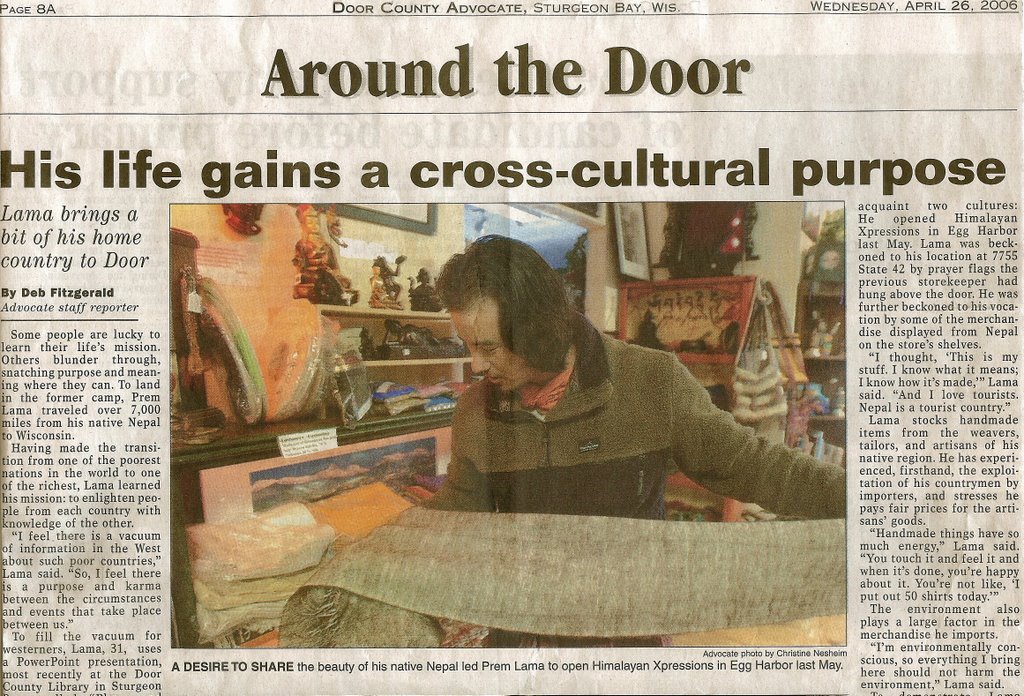
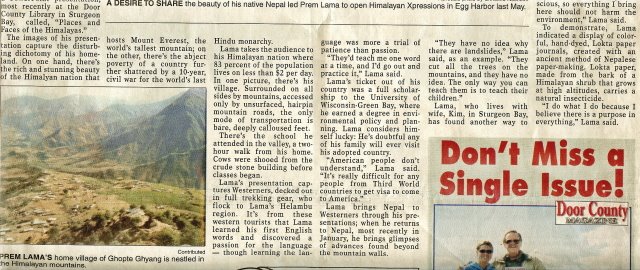
Cross-Cultural Purpose by Deb Fitzgerald Advocate Staff Reporter

This is an article on me at Door County Advocate a leading newspaper in Door County, WI USA.

Monday, April 17, 2006

Nepal faces one another problem, shortage of daily essentials supplies due to the strike! excerpts from the Kathmandu Post

Prices of food items rise
POST REPORT
KATHMANDU, April 16 - With the intensification of the pro-democracy movement initiated by the seven-party alliance, prices of essential food items and vegetables have started climbing up in Kathmandu Valley.
Talking to the Post, Pabitra Bajracharya of Nepal Retailers Association said that the price of rice has increased by up to Rs 15 per 30 kg sack, while prices of refined flour, which used to hover at Rs 22 per kg some days back, has gone up to Rs 30. "Similarly, prices of cooking oil and sugar have increased by Rs 10 per liter and Rs 12 per kilogram," he said.
According to Bajracharya, the price hike was mainly due to the obstruction in free movement of vehicles. "For the last 11 days, operation of transport vehicles has come to a virtual standstill. Very few vehicles are plying on the streets and even those that are delivering services have started demanding double the fare, which has increased the cost of business operations," he said.
He informed that vehicles, which used to charge up to Rs 250 for delivering goods, now demand Rs 500 to travel the same distance.
"With the stock of food items with retailers fast depleting and obstruction in movement of vehicles, the possibility of shortage of food materials cannot be ruled out," he said.
In the meantime, prices of green vegetables and fruits have also soared by up to 70 percent in the valley. Kalimati Fruits and Vegetable Market Development Board (KFVMDB) has stated that, prices of tomato, which hovered at around Rs 13 per kg until April 5, have gone up to Rs 22, while carrots, which used to cost around Rs 15 per kg have soared to Rs 20.
Likewise, prices of other vegetables like cabbage, cauliflower, sword bean, smooth gourd, squash and spinach leaf have increased to Rs 15, Rs 20, Rs 24, Rs 40, Rs 20 and Rs 28, respectively, from Rs 10, Rs 18, Rs 22, Rs 30, Rs 10 and Rs 24.
According to sources of KFVMDB, the prices of vegetables had increased due to disruption in movement of vehicles in the highways linking Kathmandu. "As most of the vegetables available in the local market are imported from surrounding cities such as Dhading, Kavre, Makwanpur, Bara, Parsa, Rautahat, Sarlahi and Chitwan, among others, obstruction in free flow of vehicles creates short supply, which in turn causes the price to go up," the source said.
Following disruption in movement of vehicles, prices of fruits have also gone up in the local market. KFVMDB has stated that price of bananas has increased by 100 percent to Rs 50 per dozen in the local market, while prices of apples, oranges and pomegranate have increased by Rs 10, Rs 10 and Rs 20 per kg respectively to Rs 65, Rs 50 and Rs 80.
Posted on: 2006-04-16 21:37:00 (Server Time)

Friday, April 14, 2006

A letter from a 10th Grader in Kathmandu, Nepal.


This new blog is based on my little sister “Dawa Dolma Lama”s email who lives in Kathmandu, Nepal.
Dawa D. Lama is in 10th grade and giving her final exams these days.

"My dear brother,
Hi
My exams are over. There is still computer practical left. I have been doing nothing after the exams since there were strikes and revolution going through out the country. It has been a week since the protest started.

Many protesters are jailed, killed and injured. Many public places, offices has been vandalized and devastated. The police themselves have started to vandalize the vehicles and loot restaurants and they try to blame it on the Maoist. Even when there is peace rally held against this system; streets are bombarded with tear gas and bullets.

Our king is not responding at all. May be he'll make a speech tomorrow concerning the critical matters. Foreign countries are giving comments on the country's critical situation. Even the American Embassy has been closed till further notice.Many protestors come on street everyday. Today therewere 10,000 protestor protesting in Ilam. Everyone's life has been affected in one way or the other. If nothing is done now, it will never be done in the future.

World peace with love

Dawa.

P.s.Check for the card we send u. Happy new year 2063!!"__________________________________________________Do You Yahoo!?Tired of spam? Yahoo! Mail has the best spam protection around http://mail.yahoo.com